
Maya Lozinski, MD, PhD

Health economist · Resident, Massachusetts General Hospital

Portrait of Maya Lozinski

Welcome! I am a health economist and a resident in internal medicine at Massachusetts General Hospital. I completed my M.D. and Ph.D. at the University of Chicago. In my research, I investigate the economics of medical complexity and increasing physician specialization.

My work and training have been supported by the Agency for Healthcare Research and Quality, the Becker Friedman Institute, the National Institutes of Health Medical Scientist Training Program, and the National Institute on Aging MD/PhD Program in Medicine, the Social Sciences and Aging.

Research

Knowledge Growth and Specialization: Evidence from Oncologists

Revise and Resubmit at Journal of Public Economics

This paper investigates how expert workers respond to knowledge growth. Medical oncology has seen rapid growth in knowledge: the total length of cancer treatment guidelines grew more than fivefold between 2002 and 2020. I estimate how oncologists’ specialization responds to knowledge shocks using unexpected growth in the guidelines for the cancer types they treat. Less specialized oncologists did not become meaningfully more specialized, either over time or in response to knowledge shocks. In contrast, the most specialized oncologists became more specialized over time, but the estimates neither confirm nor rule out that knowledge shocks contributed to this rise. The highest levels of specialization are concentrated in large markets and large academic organizations. Median specialization among oncologists, however, is low and changes little with market or organization size outside academic medicine, consistent with limited returns to specialization for the typical oncologist. More specialized oncologists increasingly prescribe newer drugs and have more experience with each drug they prescribe than less specialized oncologists, suggesting a growing gap in technology adoption and quality of care. Specialization therefore appears under-rewarded, yielding limited private returns despite potential gains for patients.

Mentions: Marginal Revolution, Hacker News

Working paper: SSRN

Market Size and Trade in Medical Services

with Jonathan Dingel, Joshua Gottlieb, and Pauline Mourot

Revise and Resubmit at American Economic Review

We uncover substantial interregional trade in medical services and investigate the contribution of regional increasing returns. In Medicare, one-fifth of production involves a doctor treating a patient from another region. Larger regions produce greater quantity, quality, and variety of medical services, which they “export” to patients from elsewhere, especially smaller regions. We estimate regional quality based on patients’ travel choices, and these revealed-preference estimates align with clinical outcomes. Demographic-based instruments and a case study show that greater local demand increases quality and exports, consistent with economies of scale. We study counterfactual policies that lower travel costs rather than relocating production.

Resources: BFI Summary, BibTeX, Public Data

Mentions: Washington Post, The Center Square, Chicago Booth Review, For All, Pittsburgh Post-Gazette, Health Leaders Media, Healthcare Brew

Working paper: NBER Working Paper w31030

Resources

Advice for students interested in MD-PhDs in the social sciences

MD-PhD or MD-Masters? Advice For Undergrads Interested in Health and Social Sciences

This is my first post in a series about joint degrees in medicine and social sciences, in response to frequently asked questions from undergraduates.

Introduction

As an MD-PhD student, I frequently get asked to speak to younger students about graduate school.  Students concerns are often as follows. They know they want to go to medical school and study social sciences. But should they pursue a master’s degree or a PhD in the social sciences? They find it hard to tell the difference (and justifiably – they haven’t pursued either yet).

I confess that when I applied to graduate school, I thought that a PhD was just a Master’s with 2+ years of research tacked on (it is definitely not). Now that I am a little older and wiser, I wanted to share what I wish I had known when I applied. In particular, I will focus on the key differences between a master’s and a PhD when combined an MD. I will also discuss what students should consider when choosing between the two.

About me:

As an undergraduate, I knew I wanted to study medicine, but I also loved my economics courses. I also saw the two fields as closely related – many of the biggest issues in medicine were problems of economics.  In a world with extensive need, how do we (and how should we) allocate finite resources?

At the time, I found the internet awash with information (and opinions) about whether people should go to medical school. But I found almost no information for students like me, someone interested in both medicine and social sciences. Compared to the volume of conversation about medical school, the silence was frustrating.   I agonized a great deal about whether to pursue an MD-PhD or an MD only (with the possibility of a master’s degree).  At the time, I made my best guess as to the right choice and took the plunge. I started an MD-PhD program with a PhD in applied economics at the University of Chicago. Now, I am grateful to the mentors who helped guide me in this direction, and I know that I made the right decision for me.

So now that I know more, I wanted share what I have found to be the salient differences and important considerations when choosing between paths that involve both medicine and the social sciences (MD/PhD or MD/master’s):

Important Differences:

Coursework:  PhD coursework is typically more advanced than master’s coursework. Most master’s courses assume students are new to the field and cover topics at an introductory level. For example, the master’s-level economics courses in my department were similar to my undergraduate classes. As someone who majored in economics, those classes would have been a repeat of material I already knew. However, I know some students who felt these classes greatly expanded their horizons, in part because they were new to the subject.

In contrast, my PhD coursework assumed a strong foundation in math, statistics, and undergraduate economics. It was focused on developing a relatively specialized research skillset that would allow me to meaningfully advance the state of knowledge.

These classes would have been a poor fit for someone who wanted an introduction to the field or a bird’s eye view of topics. However, I found these classes to be deeply engaging and intellectually formative.

Stress Level: A master’s is generally less stressful than a PhD. I know multiple medical students who say that their time in a master’s or MPH program was quite relaxed compared to their medical school years. In contrast, a PhD is often no less stressful than medical school, albeit for completely different reasons. Unlike medical school, a PhD doesn’t require memorizing extremely large volumes of material. However, it does require answering a question that no one else has ever answered before (and there is usually a substantive reason why no one has answered the question before). I find that medical school involves much more day to day angst (“How am I going to memorize all these pathways by tomorrow?!?”) and a PhD involves more long-term angst (“Is my research project going to matter to anyone??”).

Application Timing: With PhDs, earlier is better.  With a master’s, later is better.

There are large benefits to applying to MD-PhD programs concurrently with medical school – namely the possibility of funding for medical school.  While I know people who pursued PhDs after starting medical school, they bore much or all of the cost of medical school.

In contrast, there are large benefits to delaying pursuit of a master’s. First, some residencies will fund them, saving you a lot of tuition dollars. Second, a master’s degree will be much more valuable if you have a clear focus area and know what skills you want to learn. A year spent developing a particular expertise is much more useful than a year spent taking a smorgasbord of introductory classes.

Costs:  The relative costs depend substantially on the particulars of the tuition, funding and length of the programs as well as your specialty choice. An MD-master’s is generally not funded but takes less time. An MD-PhD is generally funded but takes several years longer. As a result, the sticker price of an MD-PhD is lower (no tuition!), but the opportunity cost is much, much higher (3-6 years of physician salary).   In terms of ROI, the best choice is a 4-year joint MD-MBA at good public school followed by a residency in a competitive specialty (by my back-of-the-envelope math). However, a funded MD-PhD compares quite favorably to medical school and a master’s degree at a private school.

Expertise: At the end of a master’s program, you should have a broad working knowledge of a field. At the end of a PhD program, you should have a deep expertise in several highly specific topics.

Disciplinary vs Interdisciplinary: Professional master’s programs, such as MPPs and MPHs, are often quite interdisciplinary, with students taking introductory classes from experts in a variety of fields. In contrast, a PhD is a disciplinary endeavor. One becomes an expert in the methods, past work, and ways of thinking in one field (maybe two).

Type of Research: As an MD, you can be the principle investigator on a study without a PhD. You will approach questions as a doctor first. The novelty in your research will come from the questions you ask.

In contrast, as an MD-PhD, your research will be highly oriented towards the discipline you trained in. You will approach questions as an economist/anthropologist/etc. Hopefully, you will innovate in terms of methods and rigor applied to the question (and you will care a lot about methods, to an extent which will irritate your medical colleagues).

Goals: Master’s programs explicitly prepare students for work in variety of roles, including business, government, administration, etc. For example, an MD-MBA would prepare someone to become a hospital administrator or a healthcare entrepreneur. Similarly, an MD-MPH would prepare someone to work in an NGO or a government public health department.

In contrast, PhD programs intended to train students to become researchers. Of course, the skills learned in a PhD can be used in many settings like NGOs and think tanks. But the goal held up by your mentors and peers will be to become an independent researcher in an academic setting.

To summarize:

  • Do an MD-PhD if you want to become an expert in a social science discipline and are happy to give up several years of being a full-fledged physician to do this.
  • Do a master’s degree if you want to be doctor first and foremost, but also develop business/public health/policy skills.
  • Consider the finances of each choice and plot your course to optimize these.

Ultimately, the right choice also depends on your vision of a rewarding professional life. Both choices offer many wonderful opportunities to learn, grow, and do meaningful work.
MD-PhD in Health Economics Admissions – Coursework

This is a continuation of my series on joint degrees in medicine and social sciences, in response to the frequent asked questions I receive from undergraduates.

The coursework requirements to be eligible for a joint program are substantial. The MD and the PhD each have their own set of pre-requisites. And unlike standard MD-PhD programs, there is essentially no overlap between the two sets of courses. For medical school, the pre-requisites are highly official and easy to find information about. For PhDs, the pre-requisites are equally binding, but often not laid out as explicitly.

Required Pre-Med Coursework: You can find information about pre-med requirements in many locations, but to quickly summarize:

  • 1 year of Biology
  • 1 year of General Chemistry
  • 1 year of Organic Chemistry
  • 1 year of Physics
  • 1 semester of Biochemistry
  • 1 year of English
  • Some combinations of basic, univariate calculus and/or non-calculus-based statistics

Bonus Pre-Med Coursework: Additional upper-level biology courses. Medical school classes (e.g. histology).

The only classes here that (sort of) prepares one for a PhD are the calculus and statistics. However, the PhD preparation requires much more advanced calculus and statistics.

Required Pre-PhD Coursework: I will speak to requirements for programs in Health Economics, Public Policy, Health Services Research and other related fields. These requirements are just as firm as the pre-med requirements, but less official, as PhD programs do not have a central governing body (like the AAMC for MD programs) to issue explicit rules.

  • Multivariate calculus (1 course)
  • Linear Algebra (1 course)
  • Econometrics (1+ courses)
  • Statistics and Probability Theory (Calculus based, ideally)
  • Intermediate undergraduate level economics

Helpful (but not strictly required) pre-PhD Coursework: These courses will strengthen a student’s PhD application and prepare the student for graduate school

  • Real Analysis: This course is essentially a requirement for admissions to a straight Economics program. Public Policy schools’ value it highly but it is not a strict requirement. I suspect health services programs value it but do not require it.
  • Additional math at the advanced undergraduate level, e.g. differential equations.
  • Additional statistics courses, at the advanced undergraduate level or master’s level.
  • Economics major.
  • PhD level Econometrics coursework.
  • PhD level Economics Coursework.

These courses will help in both being prepared for a PhD and in being admitted to a PhD.

Useful (but not evaluated) Coursework: The following coursework have proved invaluable to me as a PhD student. However, they are not hard or even soft requirements for admissions.

  • 1 year of introductory programming/computer science.

PhD classes expect you to perform statistical programming. All empirical research requires substantial programming. Programming is a core part of the work I do day-to-day. Yet for some bizarre reason, programming coursework is not required of incoming students or officially taught to current students.

I highly recommend taking a programming course in undergrad, if possible. If not, I recommended taking one in the very first elective spot available in your PhD coursework.

  • Academic and Professional Writing.

Writing effectively is a critical part of being an effective academic. Read any paper from a well-known academic and chances are that it is beautifully written. I don’t mean beautiful as in florid metaphors or oblique symbolism. I mean the writing is impeccably crafted: precise, succinct, and extremely well-organized. There are no extra words or redundant sentences. The paper is quick and easy to read, despite containing complex concepts. It takes you on a journey, and makes you think there was a clear path from point A to evidence B to conclusion C.

Yet for some reason, PhD programs typically don’t have courses on effective academic writing. I took a course on academic and professional writing as a senior in college. I use the principles I learned in that class every time I write something academic.

MD-PhD in Health Economics Admissions – Testing

This is a continuation of my series on joint degrees in medicine and social sciences, in response to frequently asked questions I receive from undergraduates.

The short version: Take the MCAT and the GRE. Do well on the MCAT and GRE quantitative section.

The longer version: Like with coursework, there are no efficiencies or shortcuts here. You have to separately prepare for MD and PhD admissions and earn test score competitive for both.

MD admissions require the MCAT. Officially, many programs do not have score cutoffs. Unofficially, they expect top tier MCAT scores. You can find evidence of this in the extremely high average scores of matriculating students. Consult elsewhere on the internet for more specifics on what constitutes a “good” MCAT score (there are any number of resources discussing this topic).

Do not expect any leniency in evaluating your MCAT score because you are a dual degree applicant. A high GRE score will not in any way make up for a low MCAT score. Your MCAT score needs to be competitive for traditional MD-PhD admissions (a higher bar than MD only applications).

PhD admissions often requires the GRE. MD-PhDs in non-traditional disciplines often have to apply separately to the PhD program. Applicants apply though the standard PhD applicant portal and are evaluated by the PhD admissions committee.

Some programs will consider health services applicants through their standard MD-PhD pipeline. At these schools, you would apply to MD-PhD program through AMCAS with your MCAT score and be done with it. GRE scores are not necessary. These programs tend to be oriented towards health services/public health research and very closely affiliated with schools of medicine.

However, having (good) GRE scores will open more doors.  Many programs (including the UChicago MeSH program) require a separate application to the PhD program(s) of interest. PhD programs generally require a separate application is they are not explicity health focused (e.g. PhD programs in economics, public policy, history, anthropology, etc.) around the country.

PhD programs in health economics and allied fields usually care only about the quantitative GRE score.  So don’t sweat your score on the verbal section (Finally, something you can relax about!). However, expectations for the quantitative section are high.

The quantitative GRE score is often used a screener nowadays. PhD programs use the GRE score the winnow down the applicant pool to a manageable size. The surviving applications are read and considered for admission.

As such, a high quantitative GRE score is essentially a requirement for admission to the PhD. However, a high score alone won’t get you in. Everyone being seriously considered for admission has a high score.

What is a high enough score? My sources say high 160s (ideally 167+) to get through the screener. However, you may want to consult elsewhere on the internet or with admissions offices, as the cutoffs can change year to year.

A final note: For PhD admissions, PhD only standards generally apply. At a minimum, you need to be a qualified applicant, which includes a high GRE score. The joint degree may help you stand out in the large pool of qualified applications.  Anecdotally, PhD programs are a tad more forgiving for MD-PhD applicants. However, the extent of that forgiveness should not be overstated. Top ranked PhD programs may not be forgiving at all. However, lower ranked PhD programs may be a bit more flexible.

MD-PhD in Health Economics Admissions – PhD Departments

This is a continuation of my series on joint degrees in medicine and social sciences, in response to frequently asked questions from undergraduates.

Health economics can be studied in numerous types of PhD departments, with a range of flavors.  Here I have listed some of the key considerations when deciding where to pursue a PhD.  I then discuss how these vary between Economics Department, Public Policy Schools, and Public Health Schools

Key Considerations:

  • Coursework: Coursework will consume a substantial amount of your time as an early PhD student. Those courses should teach skills and subject matter you want to learn.
  • Peer and Faculty Research Interests: Your peers and faculty will shape your research topics and provide critical feedback on your work. Your will have to convince them your research is interesting and robust. Their perspective and research background will profoundly shape your research questions and taste.
  • General Pros and Cons: Some additional considerations to have in mind.

Economics Departments and Business Schools

  • Coursework: Macroeconomics, microeconomics, theory-oriented econometrics (first year); Economics field courses in topics such as labor economics, public economics, industrial organization, etc. (second year).
  • Peer and Faculty Research Interests: Similar to field course topics. Industrial organization, trade, behavioral economics, macroeconomics, labor economics, etc.
  • Pros: Arguably the most prestigious. Most robust training in economic and statistical theory. Broad training lets you easily bring new methods and concepts to health economics. Easier to get jobs in a range of departments across the spectrum.
  • Cons: Very little of the material covered in courses will explicitly health focused (<10%). Vast majority of your audience be economists who don’t know or care that much about healthcare. You will need to convince them why your research topic is interesting and applicable outside of healthcare (They will not be satisfied if your research question *only* addresses an important problem in healthcare; the problem must also be broadly “economically interesting”).   Most of your audience will think JAMA (and other top medical journals) are second rate journals.

Public Policy Departments

  • Coursework: Microeconomics and causal inference oriented econometrics (first year); Economics field courses and various elective courses as desired (e.g. methods courses in CS or stats; Subject matter courses on energy, environment, education, etc).
  • Peer and Faculty Research Interests: Applied microeconomics on topics such as crime, international development, social programs, educations, healthcare, etc.
  • Pros: Robust training in economic and statistical methods. Training is more applied and less theoretical, with more direct applicability to health. Broad training lets you port new methods and concepts from subjects to health. For example, the techniques used to study judicial sentencing and teacher performance can be adapted to study physicians. More respect for applied problems. One can generally move to a healthcare policy or management department afterwards (transitions to economics department seem to be more challenging).
  • Cons: A minority of material covered in courses will be health focused (<20%). Again, most of your classmates will not study healthcare, so there will still be some pressure to make you research “economically interesting” outside of healthcare. Finally, nobody understands what a “Public Policy” degree is (I just tell people I study health economics to avoid confusion over the term “Public Policy”).

Healthcare Policy and Management Departments

  • Coursework: Statistics and Econometrics; Microeconomics; Introduction to the US Healthcare system.
  • Peer and Faculty Research Interests: Healthcare policy, healthcare management, healthcare administration, etc.
  • Pros: The training is more focused on healthcare. People will respect if you work on big problems healthcare, even if they are “only” relevant in the context of healthcare. Peers and faculty will have a much higher baseline level of knowledge about the healthcare system. You may have more support and resources to draw on for navigating complex healthcare datasets and institutional details.
  • Cons: Overall, the training is more narrowly focused on health economics and domain specific healthcare knowledge. You may not get as broad a perspective on methods, theories, and issues in other areas of economics (e.g. labor, IO, etc). On the one hand this saves a lot of time that would be spent learning irrelevant material. On the other hand, it may limit your ability to arbitrage across fields, by bringing new developments in, say, public economics, to health economics.

Public Health Schools (Health Services/Health Economics Track)

  • Coursework: Biostatistics, Health Services Research methods (very applied, relatively non-theoretical causal inference methods), Introduction to the US Healthcare System, Epidemiology, Introduction to Grant Writing
  • Peer and Faculty Research Interests: Health services research in various areas, biostatistics, epidemiology.
  • Pros: Research is often more clinically relevant. Formal curriculum includes grant writing (nearly 100% of MD-PhDs researchers are in grant funded departments, even if they study social sciences) and faculty are also expert advisors in grant writing. People have more respect for domain specific knowledge, which is a strength/interest of MD-PhD students.
  • Cons: Researchers from public health schools often end up more narrowly focused on a very specific domain of health or healthcare (similar to healthcare management schools). They become experts in the payment systems for exactly one type of healthcare, such as nursing homes, or the costs of various drugs for specific type of cancer. Domain specific knowledge is highly useful, but it can come at the cost of more rigorous economics training. The research is often deeper in the weeds and contextually rich but sometimes lacks a connection to the fundamental economic forces at work. Research agendas tends to focus around a domain topic (e.g. cancer drug costs), rather than a particular method or theoretical approach. Also, it may be challenging to move to the other types of departments discussed previously from a public health department.

Final Thoughts:

  • The best training path is the one that fits your interests. If you don’t know what that is, look where researchers you admire did their training (Important Note: This often fairly different from where they work now. Most economists in public health schools did their PhD in healthcare policy departments and most economists at health policy departments did their PhDs at Economics/Business schools).
  • In my observation, people tend to move in the direction of studying more applied problems over the course of their research career. One’s PhD is often the high-water mark of theoretical and, for many, cutting edge methodological knowledge.
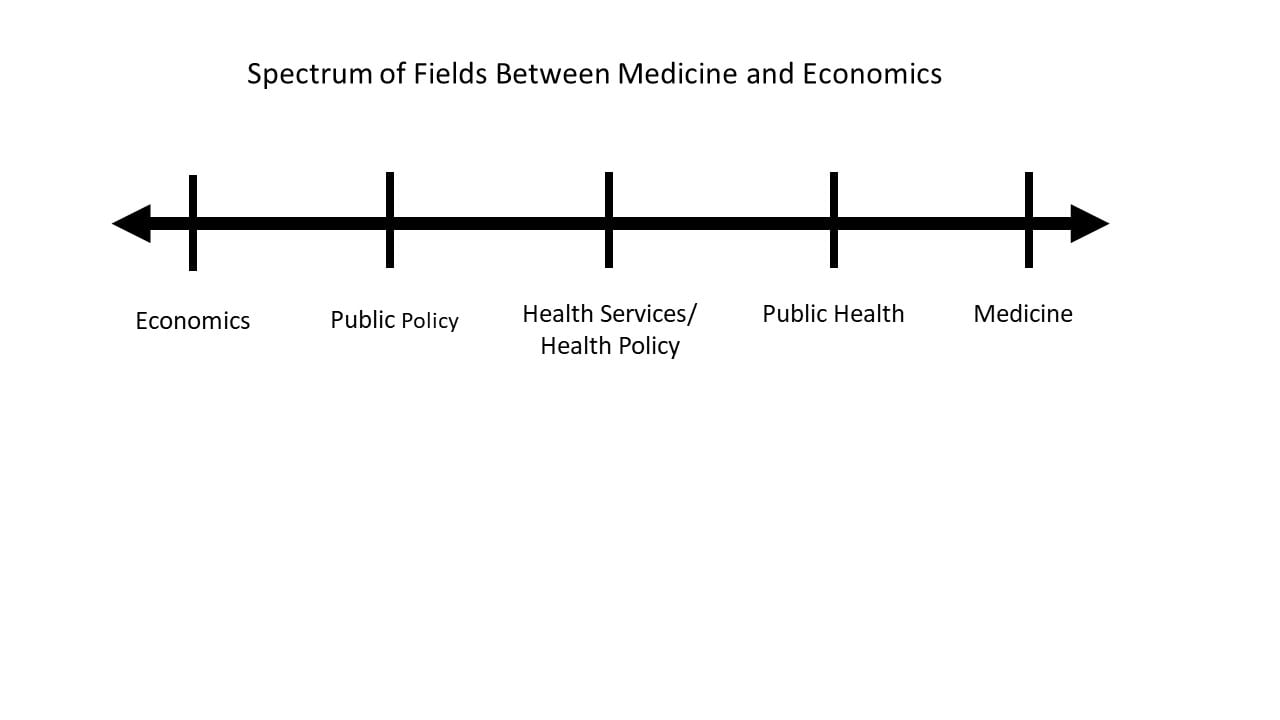
  • Transitions seem to be easier in the direction of: Economics (most theoretical, least applied) à public policy à healthcare management à public health (least theoretical, most applied).
  • A reasonable strategy is to aim for a program which is slightly more theoretical and less applied than the work you ultimately aspire to do. One advisor told me that you need to overtrain a bit for the research that you want to do. You should always aim to use research methods that you understand more than strictly necessary, theories which you know forwards and backwards, etc. This strategy helps you avoid mistakes and do robust research.
  • All that said, when picking a PhD department, there’s no wrong choice of discipline! People do creative and impactful work in all varieties of methods, subject areas, and disciplines.

Spectrum of fields from economics to health services research

Checklists and notes on presenting and communicating research